Monday, May 30, 2016

HEADING INLAND


We spent 6 wonderful days in Brookings at Harris Beach State Park.  We managed to get a couple of hikes in along with walks on various beaches.  After laundry and a resupply, we headed inland toward Grants Pass.  We settled in at a Indian Mary County Park which is right on the Rogue River.  We are very familiar with this campground having stayed there many times going back over 30 years.  It was the Memorial Day weekend, so it was best to stay in one place.  We have two sets of friends in the area and we had great visits with both of them.  We only managed to get in one hike while there, along the cliffs above the river to Rainie Falls.  These falls have three routes one in a kayak or raft can take.  A class 3 a 4 and a 5.  We watched as rafters and kayakers took the class 3 and 4 rapids.  No one opted for the class 5 rapid.


Speaking of Kayaks, we have an inflatable two person kayak of sorts that is very stable.  We had in some class 2 Rapids and it performs well.  The issue I have with it is that due to it's design you are constantly sitting in the water. It's doesn't get used much.  I wanted a hard shell stable Kayak that would keep me dry, unless of course I turned it over.  Cathie didn't.  So by saving my allowance I managed to buy my own kayak.  Turns out REI (outdoor store) was having a sale so I checked their kayaks out.  I settled on a Elie 10 footer that was advertised as stable.  I figured that if I couldn't mount it on the RV"s ladder to the roof, it would fit inside.  There was the added bonus of buying it in Oregon as there is no sales tax.  I liked the idea of cheating the State of California out of the sales tax.  Lo and behold, it mounts on the RV ladder for easy transport.


For my first tryout in it, I opted to avoid the rapids of the Rogue River and waited till we arrived at our next stop with calmer waters, Lake of the Woods. So for my maiden voyage I took a slow paddle around one end of the lake and everything we just fine until coming back to the boat launch.  As I came ashore, the local sheriff was docking his boat at the ramp.  I mentioned to him that it must be fun to have such a great assignment.  This of course drew his attention to me and my kayak.  Turns out I needed an "Invasive Species Permit" to operate my "boat" in Oregon waters.  I was also lacking the required whistle.  So, being a nice guy, and I wasn't about to be an ass, he inspected my "boat", gave me a nice red inspection sticker to paste on it and the required whistle.  Then suggested that within the next 15 minutes I run over to the marina a purchase the Invasive Species Permit for $7 and he would let me off with a warning.  Not being stupid, I did just that.


Monday, May 23, 2016

THE BROOKINGS BOMBING

I seem to remember learning that during WW II the Japanese shelled the west coast, but did you know that they also bombed us, twice?  Yes it's true and I'm here to tell you the story.

After Jimmy Doolittle raid on Tokyo in April on 1942, the Japanese wanted to demonstrate that they also had the ability to bomb the United States.  So, on September 9th, 1942 they did just that.  Early on that morning the Japanese Submarine I-25 surfaced off Cape Blanco on the southern Oregon coast.  On board was a small seaplane which the crew assembled on the deck of the sub. The plane, piloted by Warrant Officer Nobuo Fujita and along with his navigator Shoji Okuda, was catapulted off the submarine with compressed air.


The plane carried two incendiary bombs and the intent was to start a massive forest fire.  Fujita flew to Mt. Emily, east of Brookings, Oregon where Howard Gardner, a civilian plane spotter, saw the plane as it circled the mountain top lookout station.  He reported to the forest service in Gold Beach that he had spotted the plane.  The plane dropped it's bombs and Gardner spotted smoke from the fire about six hours later.  He, along with another spotter and two other men, hiked to the fire and extinguished it.  At the site they found 40 pounds of bomb fragments with Japanese markings.  They knew that for the first time in history, America had been bombed.  The fire caused little damage as it had rained the night before and the forest was damp.

 
FRED FLYNN WHO HELPED PUT OUT THE FIRE HOLDING BOMB FRAGMENTS

Fujita returned to the I-25 and landed safely.  Shortly after the bombing, planes from the USAAF spotted the submarine and attacked.  They caused minor damage and the sub was able to submerge and hide on the bottom off Port Orford.  Three weeks later on September 29, Fujita flew once again over the US mainland and dropped two more bombs.  They apparently caused little or no damage as the attack was never discovered.  The I-25 returned safely to Japan where news of the attack spread quickly throughout the country.  Fujita remained in Japan for the rest of the war and became a flight instructor.  After the war he owned and operated a hardware store..

Fast forward 20 years to 1962 and Nobuo Fujita, at the invitation for the Brookings Jaycees, attended the Brookings Azalea Festival.  The highlight of the visit was when Fujita made a presentation of his 400 year old Samuri sword to the people of Brookings as an apology for his wartime bombing.  The sword was the same one that Fujita carried with him on his bombing raids.

 
Today you can go to the site of the bombing where there are storyboards telling of the attack.  So that's what we did. The sword is on display in the library in Brookings.

 
THE POINT OF IMPACT


Sunday, May 22, 2016

CONTINUING NORTH ALONG THE COAST

So far this trip has been pretty uneventful and I suppose that is a good thing.  We've been spending our time on long scenic walks and a few scenic drives thrown in.  While staying at Bodega Bay we drove down the Point Reyes National Seashore for a hike along the coast.  I had an Aunt who lived in a small town next to the park so we've been there many times before.  


We took a second coastal hike just north of Bodega Bay along the Sonoma Coast State Park.  The park extends for 17 miles from Bodega Head to just north of Jenner, all of it easily accessible from Hwy 1.  A hiking trail follows the coast for much of the way allowing one to control the length of a hike by choosing one or more sections.  The section we chose was along the top of the bluff overlooking the beaches below.  A beautiful hike with superb views.


The next stop on our trip was to be at Jedediah Smith Redwood State/National park.  When checking on-line for a reservation there was only one site left open and it was a handicap site.  In Federal parks if the only site left is a handicap site, you can stay in it even if you aren't handicapped.  So I made the reservation.  Now all the redwood parks in California are joint state and national parks.  When making the reservation I was able to use my National Parks Pass and receive the appropriate discount.  Upon arrival at the park the state park ranger in charge didn't see it that way and refused to allow us to occupy the site.  Needless to say, after driving over 300 miles, I was pissed but opted not to get into a gun battle with the ranger.

This actually turned out to be a blessing in disguise.  We had planned to go to Brookings, Oregon after the Redwoods so we continued north another 20 miles and managed to snag a primo ocean view campsite at Harris Beach "Oregon" State Park.  Much better than Jedediah Smith as camping in the Redwoods is gloomy because the sun never reaches the ground and I don't like the ranger.  Also this site at Harris Beach has hookups with cable tv and sunshine.  (Except it's raining today.)


We did return to the Redwoods for a nice hike through the tall trees.  We hiked the Boy Scout Trail to check out the Boy Scout Tree, the largest tree at Jedediah Smith Park.  On the hike out, I heard Cathie fall, a sound I have heard before.  When I turned back she was just getting up  and on the tip of her nose was stuck a four leaf clover.  It looked so funny, I just couldn't stop laughing.  Luckily, other than her pride, she wasn't hurt and laughed right along with me.  No photo though.


Sunday, May 15, 2016

A TRIP TO NORTHERN CALIFORNIA

As I write this, we have just arrived in Bodega Bay. We are in a county campground on the bay with the ocean just across the road. Nothing exciting has been happening and much of our time is spent on country drives, relaxing and reading. We spent the first four days at Pismo Beach and did a lot of walking on the beach. For $5 you can take your car and drive on the beach, which at low tide is a broad flat expanse of sand. We opted to walk and keep the salt off of the truck. South of town the beach and dunes are open to ATC's and for a princely sum you can rent one. Being midweek it appears that business is slow.

We managed to hookup with Howard and Joy in Morro Bay for lunch. I met them in Spain on the Camino and they are part of my Camino Family. We enjoyed catching up on the latest news and reminiscing about our time on the Camino.

We next continued our journey north, stopping for three days in Pinnacles National Park. We've never been here so it was time to check it out. My sister Kathy lives nearby so she joined us for a couple of days.

Lots of hiking opportunities in the park and it was time for us to get out of the recliners and get some exercise in. After being sick for a month it was slow going, but we managed to get the heart rate up and enjoy the outdoors. One of the two hikes we took involved traveling through a cave. Not really a cave, but a tunnel of sorts formed when rocks and boulders fell into place forming an opening through the rocks. How did the rocks fall in the first place? You ask. Well, Pinnacles Park happens to be within sight of the San Andreas Fault. And now the park service routes it's hiking trails through this jumble of boulders, keeping their fingers crossed that no new ones fall into place.

With no earthquakes occurring while we were there, at least none was could feel, we pulled up stakes, moved north and settled at a county campground on the beach in Bodega Bay. The wind is howling here, but that is the norm for this time of year. From our campsite we can see the ocean from one side of the trailer and the bay from the other. Doesn't get much better than this.


Wednesday, May 04, 2016

HERE WE GO


As you probably guessed by looking at the photo, we're heading out again in the RV.  We should be in Spain right now, but with both of us being ill, we had to cancel our Camino. We really prepared to that trip and were extremely disappointed that we had to cancel, but there's always next year. Pneumonia really hit Cathie hard and one month later she still not at 100%.  As for me, not sure what I had, but what ever it was is now behind me. Because I took a month off of any exercise, I'm paying the price now, getting winded easily.  I rode my bike today on my usual 40+ mile ride and it damn near killed me.

Anyway we figured we have sat around long enough and are itching to get on the road. We will head out this next weekend, this time to the north.  First up will be Pismo Beach where we hope to get some long walks in along the shore.  From there we'll continue north till we reach Southern Oregon before turning around and taking to slow way home along Hwy 395.  Along the way we'll visit mountains, more beaches, the redwoods, and a few rivers.  If you want to know exactly where we're going, follow along and we'll let you know when we know.  It is our usual custom to change plans at the drop of a hat, so we will just have to see were this new adventure leads us. 

Saturday, January 23, 2016

ANNIVERSARY TRIP TO BORREGO

BORREGO SUNRISE

Is this the 75th anniversary of our first trip to Borrego, or could it be the 40th January visit there?  Well, no, as last week we celebrated our 45th wedding anniversary.  Quite a feat if I don't say so myself and I believe Cathie would agree.  Because of the special occasion we opted to leave the RV at home and the tent wasn't too appealing for a celebration, so we rented a casita  for 4 nights at Rams Hill.  A nice enough place with everything one needs for such an occasion.

Of course anytime we're in Borrego, it's time for some hiking, so that's what we did.  There were other things that occurred, but we won't be talking about that.  As many of you may know we are getting ready to head to Spain in April to walk the Camino de Santiago.  So hiking is in the cards  until we leave in an effort to be ready to walk the 500 miles of the Camino.  We took three, not too long hikes, one to Harper Flats, one in Rainbow Canyon and lastly up Palm Canyon.  We've been to all these places before so we weren't apt to get lost.

Harper Flats is an area of heavy Native use which we saw evidence of.

NEVER SEEN THIS BEFORE

LOTS OF POTTERY

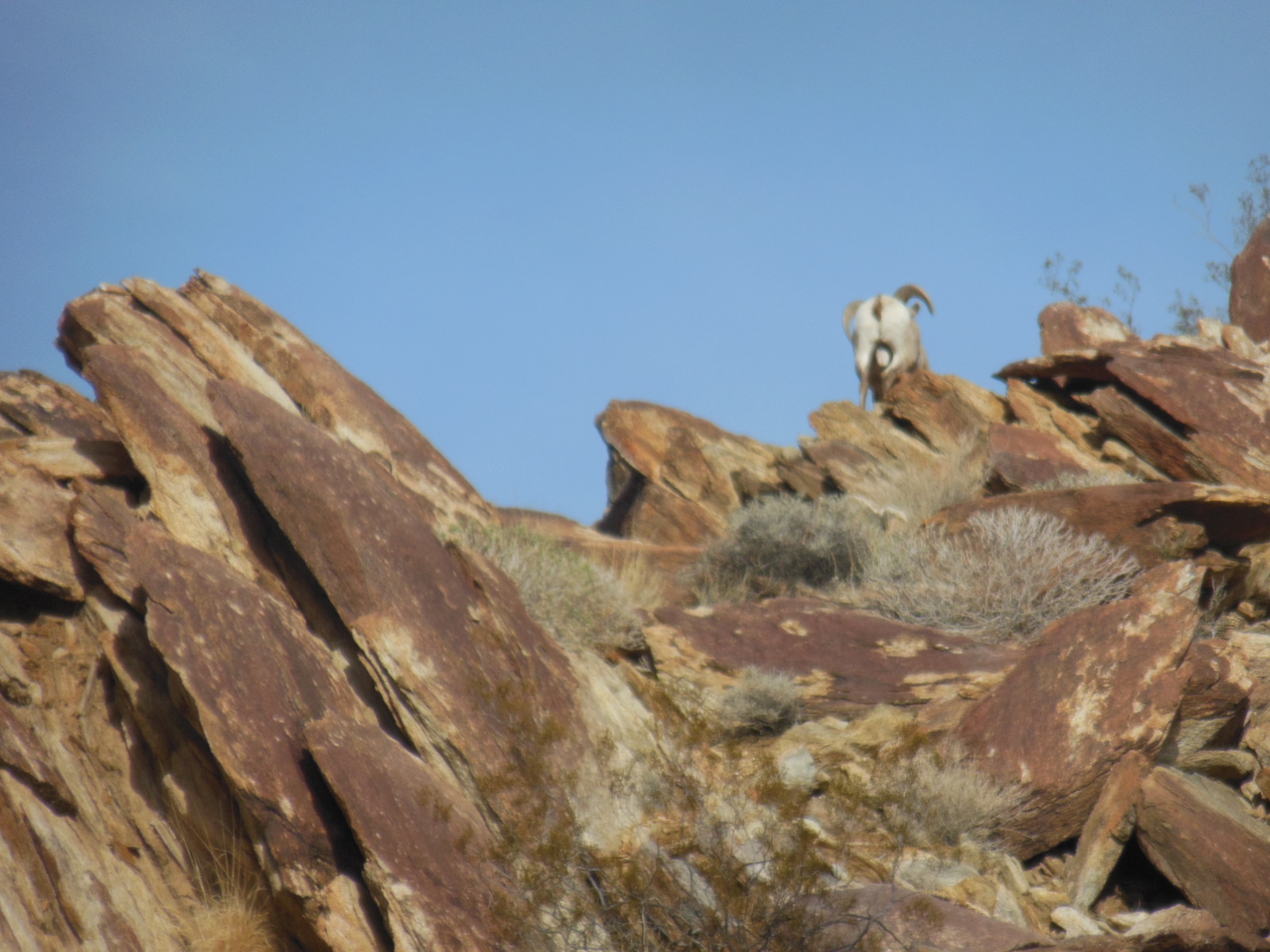
On our hike up Palm Canyon we saw four Big Horn Sheep and I somehow managed to actually get a photo as proof.

SOUTH END OF A NORTHBOUND SHEEP

I didn't take a lot of photos, but I did take our new GoPro Camera which I am still learning how to use.  Boy, is there a learning curve on this piece of equipment.  When I got it and brought it home, I started reading the manual.  It was so confusing to me that after 4 hours of trying to figure it out I almost took it back.  I kept at so that I could bore all my readers with my cinematographic talents.  So, enjoy or not, this 5+ minute video of our trip.


Gassaway's Adventures will be on hiatus for a while, but you can follow along on the Camino at:

www.walkingourcamino.blogspot.com


Thursday, December 10, 2015

THE REASON THE TREES ARE CUT DOWN

If you are a avid reader of Gassaway's Adventures, you may remember my post last August about the Juniper Trees being cut down in the Hart Mountain Antelope Reserve and I know you've been waiting for the answer as to, why?  For those one or two of you who didn't read the account at the time, this is what I wrote:

I noticed while on the refuge, that some of the Juniper trees were cut down.  Just left there laying on the ground.


Vandals, wood thieves or were they non-native trees or diseased?  So I asked a refuge volunteer who happened to drive into camp, what was up?  He told me that the trees are native, not sick and that they were being cut down to make it like it was 100 years ago in the refuge.  I said, "so you're helping nature".  He didn't like that comment.  I then suggested that if they wanted it to be like 100 years ago,  he should get out of the truck and walk.  I don't think he like that comment either.

It really pissed me off.  How do they know how many trees were there 100 years ago? If more trees have grown naturally, why are they messing with nature and cutting them down?  I'm going to get to the bottom of this and find out who the idiot is who made this decision.  When I find the answer, I'll post his name and address here so you can all tell him what you think. Stay tuned.........

 I sent the following e-mail and have yet to get a response:

On a visit to the refuge I noticed that Juniper trees were being cut down.  I spoke with a volunteer who told me that they were being cut down to make the refuge like it was 100 years ago.  Is this true?  Aren't the Junipers natural to the area?  If they are what possible good could it do to cut them down?  Who made the decision to cut them down?  Unless they are a non native plant overtaking native plants, I can't imagine that you could provide me with a reasonable answer.

I sent a follow up e-mail and again, no response.  I haven't given up, so next will be a phone call.  I'll keep you apprised of any news.

I made several phone calls, leaving messages that were not returned.  I finally spoke with the receptionist and asked her to forward my request to the powers to be.  Finally on October 20th I got an e-mail from Jeff Mackay, the Refuge Manager who provided me with his phone number telling me he would be happy to discuss my query.  So, I called and left several message.  Finally on December 8th, the elusive Jeff Mackay called me. His explanation is as follows:

Image result for sage grouse

First, the trees are not invasive nor are they taking over the refuge.  But, there are Sage Grouse on the preserve and they are close to being listed as an endangered species.  Sage Grouse range all over the west and if listed as an endangered species, many changes would have to be made to private use (grazing) on federal lands.  Why, are they close to being listed?  Well, Sage Grouse live in Sage Brush and that particular plant is in decline due to fires, grazing drought and other forces.  The Sage Brush on the reserve is pretty healthy and there is a good population of the aforementioned bird because of it.  What does all this have to do with the trees, you ask?  As luck or bad luck would have it, Raptors like to eat Sage Grouse.  It is one of their favorite meals and if you ask the Raptor, quite tasty.  You see, Raptors sit in Juniper Trees until they spy a Grouse and then they swoop down and catch the little buggers.  So, no tree, the Raptors have to go somewhere else to eat, like Grandma's chicken coop.  And that, my friends is why the Federal Government is cutting down the trees.  Only new growth trees mind you, not old 100 plus years old trees.  It's kinda like, killing one piece of nature so another part can survive.  We all know the the Feds know what their doing, so no worries.

Image result for raptor bird

Actually Mr. Mackay was very nice and we had quite a long conversation.  You can call him if you like at 541-947-2731.   Oh, I forgot to ask him, what about the Raptors, are they next?

Sunday, November 01, 2015

THIS ADVENTURE IS IN THE BOOKS

Well, we've been home a week now so figured it's time to put this our latest adventure to bed.  In the last post we were in Colorado and that's where this post begins.  In Colorado and most places in the northern half of the county, the U.S. Forest starts closing their campgrounds in September and by the middle of October you are pressed to find one still open.  Outside of Woodland Park we managed to find just one still open if only for another week.  Besides the camp host and us, there was just one other camper in the campground, so we had our choice of spots.  That being said we had difficulty finding a site our rig would fit into.


After just two nights in Woodland Park we continued our journey west to Buena Vista in the middle of the Rocky Mountains.  As we explored the area we found some great fall colors.


We also happened upon one of the area's natives.


We managed to get in a couple of nice hikes in the area, the first being to Lost Lake. Located at just shy of 12,000 feet, hike was made possible because we started walking at just shy of 12,000 feet.  With no elevation gain to speak of, we managed just fine, but we did feel every bit of that 12,000 feet.  Under clear but crisp skies we topped a rise in the terrain and came upon the small lake situated just below the Continental Divide in a beautiful setting.  The lake has a small island and is surrounded by the lake's dark green color.  Since we found the lake, it's no longer lost.


The water was just a tad too cold for swimming as ice was forming around the edges.  In a matter of days or perhaps a week, the lake will be frozen over for the winter.


Our next hike was a little easie,r although still high at 11,000 feet, it followed an abandoned rail road, thus keeping the grade at a manageable angle.  We've hiked this route before but it's beauty demanded a second look.  All the rails have long since been removed, but some of the wooden ties are still there.  The Railroad was in operation from the late 1800's into the early 1900's but abandoned when a tunnel under the Continental Divide collapsed.


On the way back to camp, we stopped and paid a visit to St. Elmo, a still partially occupied gold town.


The following day was opening day of hunting season putting an end to our hiking in Colorado so we headed southwest to Moab, Utah.  Most followers of our blog know that Moab is one of our favorite places as it get mentioned here often.  We lucked out and got a campsite at Goose Island, a BLM camp on the banks of the Colorado.


We managed to get in a couple of hikes, but we were dodging thunderstorms, which in these parts can be quite dangerous.  We took a great hike to Neck Spring in Islands in the Sky district of Canyonlands National Park.  We lucked out as the rain started just as we were returning to the trailhead.


THE RAIN APPROACHES


Line at the bathroom so we opted for a bush, there was no waiting

As we were heading back to camp the skies opened up with a downpour that lasted about 45 minutes.  Glad we weren't caught out in it.  Something to see with the water cascading off the red cliffs.


I did manage to get one short bike ride in on the new bike path that goes from town and along the river.


Well, that does if for this adventure. There of course will be more.  In our next adventure we will be walking the Camino de Santiago in Spain, so you can follow along on our Camino blog, Walking Our Camino.