Sunday, May 23, 2010

SHOPPING

FRENCH SUPERMARKET

Shopping in Europe is an adventure all by its self. In France there are several large supermarket chains to choose from and they are somewhat different from those we have in the States. Carrefour and Intermarche are common as is, E.Leclerc, pronounced, la clair. They are pretty much the same and most have a department store section selling everything from clothes, to garden supplies. Most sell gas and diesel and have the cheapest price in France. Some other differences include, checkers who sit at the registers, bring your own shopping bag or buy one at the store, and bag your own groceries. Most will have an extensive and separate departments for meat, cheese and fish. There is a wide selection, which at times for us was daunting just trying to figure out what was in some of the different packaging.

SHOPPING CARTS

When you arrive in the parking lot, pick up your cart by putting a .50 coin in the slot which releases it from the next cart. When you return it, you get your .50 back. You never see abandoned shopping carts in the neighborhoods as you do at home.


SUPERMARKET BUTCHER COUNTER

SALAD AND DESSERT COUNTER

Some of the larger markets include other stores, restaurants and bars. In Germany, Wal Mart has a beer garden. We encountered several with large cafeterias. I was seated next to this large display of salads and desserts at one such cafeteria. I grabbed this picture during a lull of customers. While taking the photo I noticed one women customer giving me the evil eye. Several minutes later, I had been reported to the management and was contacted by one of the employees who wanted to know what I was doing photographing the food. The employee, a cook, perhaps thought I was stealing trade secrets for the competition. I tried to explain my purpose and thinking I was making headway I asked if I could photograph him cooking. At this point he must have thought I was completely crazy and told me "It is not permitted". He left at this point, but kept an wary eye on the strange American, while I finished my coffee.


When you buy fruit and vegetables at the grocery store, you bag them, place them on the scale in the produce department, push the appropriate pictured button and a sticker with the price and bar code is printed. This gets scanned at the cash register. At the cheese counter, the cheese is not only sold pre cut a packages, buy you can select an amount to be sliced from a large round of cheese.

CHEESE COUNTER AT L.LECLERC

The following photographs were taken at one of the many town square marketplaces. Most every town and small village in France have a weekly market, and in some larger towns these markets take place twice a week. Food is locally produced and of a wide variety. For the most part, the supermarket is cheaper.

SAUSAGES


THE BAKER


LOTS OF OLIVES


THE SPICE VENDOR


FRESH FISH


DESSERT


There's another kind of shopping. It's the kind one does while on a trip because she realizes she doesn't have enough clothes. Without any consideration on how more items will fit in the carry on, one must shop. You manage to get a great selection in the tourist shops along side the plastic swords, miniature figurines, Christmas ornaments, T-shirts that say "all grandma got me was this lousily T-shirt", and Harley Davidson memorabilia. (The latter is quite popular here in Germany).
On a recent such outing, I was at my usual post outside of the store enjoying the scenery, and I made this observation. Of the four stores of similar type, one each corner, all four had a gentleman about my age, standing outside enjoying the scenery. Goes to show you things are pretty much the same everywhere.


Saturday, May 22, 2010

GERMANY AND THE MIDDLE RHINE

SOMEONE'S WATCHING
We are now in Germany and our first stop is Bacharach one of the many small towns along the middle section of the upper Rhine River. Beautiful little towns with timbered buildings and narrow streets. It also stopped raining and we're beside our selves with happiness. Actually some warm weather for a change. We are staying in this really nice pension a small family run hotel. Its a couple of blocks from the center of town, close enough to stroll down the street for refreshment, but far enough away that we don't hear any noise. We don't even hear anyone else in the hall, no doors slamming no nothing. We think we're the only ones here until breakfast where the other guests show up. The owners assign tables by room number and manage to seat table mates with you that you can converse with, mainly other Americans.
PENSION IM MALERWINKEL
Our room is the one in the middle with the balcony and overlooks the garden. There is a small stream running by so we leave our window open at night, falling asleep to it's sound.

VIEW FROM THE BALCONY

DOWNTOWN BACHARACH

There is a castle on the hill above the town, but there is a castle on the hill above just about every town along this section of the Rhine River. That's a big reason why people come here. You can stay in Stahech Castle above the town if you're willing to stay in a youth hostel. Could be noisy. I hiked up the hill for a look, and their outdoor cafe with picnic tables has a terrific view of the river below.

One thing people do around here, besides drink beer, the local wine, or eat the vast amounts of food, is to take one of the boats that cruise the river. You head either up or down river, stopping to get off at one of the other little towns along the river. Because of the current, what takes 1 hour to go down river, requires 1-3/4 hours to come back up. Very relaxing with some of the greatest scenery anywhere. The boats are large and comfortable and serve, you guessed it, beer, the local wine and vast amounts of food.

PFALZGRAFENSTEIN CASTLE


A lot of freight is transported on the river by the ever present barge. They carry everything from shipping containers to gravel. Families live on the barges in many instances. You see children's playground equipment on the roof of the living cabin and of course the family car.
This is our fourth night here and we're heading out tomorrow for Regensburg in Bavaria only because we've got a reservation to tour the BMW factory there.


Friday, May 21, 2010

A WORD ABOUT PEEING


Finding a place to relieve oneself in a strange and unfamiliar place can sometimes be a challenge. At times you must experience the pain of a full bladder for long periods of time, until you learn to take matters into your own hands, no pun intended. When traveling on secondary roads, official rest stops and facilities are few and far between. When a actual toilet is encountered, at say the town hall in some small berg, you use it while holding your breath and hope that your current state doesn't require sitting down.
We have on occasion encountered and used facilities such at the one depicted above, where the only smell may be the cows in the adjoining meadow. It is common to see men using these open air roadside facilities with no concern about who might be watching.


When using a toilet, or as known in many locales, a W.C. one must have at least a minimal amount of knowledge of the local language so as to pick the correct door. In a small town in Germany with many foreign tourists, the owner of this restaurant made it clear with his signage.

There are different types of porcelain fixtures all over this part of the world. Some look pretty much the same as what we're used to, but in the effort to make sure you put the seat up before using, it is just removed. At the local McDonald's, a good place to go, the women's facilities consists of two thrones, one of a regular size and the other a child size.


Often the toilet is flushed by pressing a button on the top of the tank. There are actually two buttons, one larger than the other. You may select to push either, the big button for a large deposits and the small button, well you get the picture.


The old Turkish, footprints and a hole, type is abundant in older establishments. Usually not very pleasant and often times with no toilet paper. Careful when you flush, you might get your shoes wet.

Restaurants are a good place to find facilities. This one took pride in it's throne room, which was used by both sexes. If you really must go, just walk in the restaurant or cafe and head towards the back. Just look like you belong there. This ruse has worked in dire situations.

Just push a button and a new seat cover is forthcoming, out one side and in the other. There are very elaborate systems in some public places where the W.C. is in a box, similar to a porta potty, only high tech. You put a coin in to gain access and close the door. You notice right away that it's wet inside. After using the apparatus, it flushes automatically. You are allowed to exit by pushing a button which unlocks the door. Don't hang around though because if you stay to watch, you will get washed down with the rest of the interior.
It is very common to encounter an attendant in the facility. It is not necessary for the attendant to be the same sex as the user of the bathroom. If you can't go when someones watching, these places aren't for you. The advantage is that these places are usually clean. It is customary to leave a small tip in the dish provided.
Ok, you ask, what is he doing taking photos of toilets across Europe? Well, I've got plenty of photos of castles and I figured you need to read something educational.
Hey, it's all part of Gassaways Adventures.


Thursday, May 20, 2010

VERDUN


These fields are being cultivated all over Northern France and Germany. Very bright yellow that looks like the wild mustard that grows in California in the spring. But it's rapeseed, used to make canola oil and more recently, bio diesel.


LA METAIRIE DU MANOIR


This is our B&B near Verdun. One of the nicest places we've stayed so far. Very large room with lots of antiques. This is a beautiful home owned and operated by Mr. and Mrs Wurtz, a retired couple who grew up in the village. Very nice people and we opted to have dinner with them one night. Five courses with wine, topped off with a home made plum liquor that Mr. Wurtz said was 50% alcohol. After one sip, I didn't doubt him for a minute.


OUR ROOM


Here's their web site: http://www.lametairiedeverges.com/

We came to Verdun for the WWI sites. On our last trip to France we went to Normandy and went to lots of sites we had learn about over time. We here less about WWI, but had heard of Verdun on many occasions. Cathie's grandfather fought somewhere in the area, although his exact history is unknown. When one thinks of America's overseas military cemeteries, you usually think of Omaha Beach. Near Verdun is the Meuse-Argonne American Cemetery. It encompasses 130 acres captured by the 32nd Infantry Division. Free use of the land, as a permanent burial ground, was granted by the French government in perpetuity, without charge or taxation, as an expression of its gratitude to the United States.

There are 14,246 American war dead interred in the cemetery, most of whom fell during the operations of the First U.S. Army, between September 26 and November 11, 1918. The graves include 486 "unknowns". This is the largest U.S. military cemetery in a foreign county. In the memorial at the site are inscribed the names of the 954 missing, who remains were never recovered.

It is interesting to note that the grounds are overseen by American employees of the American Battle Monuments Commission, some of who live on the site. The cemetery is immaculate. Much better cared for than any monument in Washington DC. Perhaps that's because the man in charge is a U.S. Army General. While we were there, we noticed that some of the crossed were being dug up. We learned that some had become misaligned and they were being realigned so that the rows were straight for all angles.


One of the many trenches that are still evident today. This area was devoid of trees during the battle of Verdun. The trees have since grown, but you can still see the results of 300 days of bombing, shelling and trench warfare.


This is the interior of the Ossuary at Douaumont, the final resting place of the remains of around 130,000 French and German solders collected from the chaotic battlefield. the remains were initially placed in coffins bearing the names of the sectors where they had been found, in a provisional Ossuary. The current building we erected in 1920 and the remains were entombed beneath the building. These are all unidentified remains. There are windows where one can looked into the burial chambers and see the bones of the fallen. In front of the monument are the grave of 15,000 French solders who were killed in battle. You can read more about the monument here:


On the same battlefield are the ruin of several forts built by the French as a defense against invasion. These fort were constructed in the 1880's and were improved upon over time. As the Germans advanced in WWI they captured many of the forts and occupied them until the French took them back later in the war. We toured Fort Douaumont which was a complex of underground tunnels and spaces where the solders lived and worked. The fortifications consisted of machine gun emplacements and large cannon. Quite impressive.

The above photograph if of a shrine to German solders who were killed and entombed in the walls of the fort as a result of an explosion of munitions.


TUNNEL IN FORT DOUAUMONT

There were over 3 kilometers of tunnel and passages in the fort. Spaces included kitchens, barracks, chapel, and administrative offices, not to mention the armament.


Wednesday, May 19, 2010

REMEMBER

DORDOGNE FLOWERS
We spent 6 days in the Dordogne and I still can't pronounce it the way the French do. When someone asks me where we've been and I give them my pronunciation of Dordogne, they haven't a clue where it its. I have to show them on a map or write it out for them. Then they get a good laugh at the way this crazy American attempts to speak French.


We said goodbye to Ken and Linda, who I might add were superb hosts and started a two day 700 km drive to Verdun. On the first day of the drive we made a detour to see Oradour sur Glane, a village that was destroyed by the Germans in WWII. The village has been left as it was after the Germans killed all but a few of the residents and burned the village.

On June 10, 1944 a column German solders entered the village and began rounding up all the residents. They were told it was for an identification check and to search the village for weapons. Up until this time, the residents had not had any real problems with the German Army, so there was no resistance. Once all the villagers were assembled, the men were separated into six groups and taken to different barns in town. The women and children we taken to the church.
After about 1 hour, the Germans began machine gunning the men and setting the barns on fire. A fire bomb was place in the church and ignited. 642 men, women and children perished. The only survivors were 5 men who escaped from one of the barns and one women who climbed out a window behind the alter in the church. The entire village was burned, destroying every building. All that is left are the remains of walls and things that were made of metal.
The French government has left the village as it was then as a reminder. A new village was built next to it. As you walk through the destruction, you can see everyday items that would be in any home and business. I was surprised to see so many sewing machines, but I suppose every household had one back then. There are bicycles, frames of baby carriages, farm equipment and cars and trucks still in their garages. It was a very moving experience. There are small plaques on most of the buildings identifying who lived there or the name of the business that occupied the site.


THESE TWO SIGNS ARE AT THE ENTRANCE TO THE VILLAGE


Saturday, May 15, 2010

EATING OUR WAY ACROSS FRANCE

FOOD

Eating here in France is necessary to survive, but it is also an adventure. The downside, if there is one, is that we eat too much.

BREAKFAST

At our B&B's an ample breakfast is served with an over abundant amount of bread, which is usually fresh and many times hot out of the oven. It tastes so good, you tend to overeat. Then comes coffee, juice, jams, honey, different types of cereal, fruit, yogurt, cheese and at times some kind of cold cuts. Now if your disciplined you eat a little of one thing or another, but we haven't been disciplined yet. You just gotta try everything. So after a long and slow breakfast, we push back from the table and head out for the day.

LUNCH

We usually eat lunch around 1:30 in the afternoon. This is partly because most restaurants in France close around 2 pm and don't open again until dinner time, which here is around 7 pm. But the main reason we eat lunch when we do is because we're too full from breakfast to eat any sooner. On most days we try to make lunch our main meal of the day. So with our French menu decoder in hand we start looking at menus for something we can understand. All French restaurants post their "carte" outside along with the "plat du jour" or the dish of the day. The daily offering is usually the best option for the price. Normally comes with a starter, like a salad or soup, a main dish, and desert or cheese plate. Drinks are usually extra. Food here is expensive, but the wine is cheap. A 1/4 liter of wine, about two glasses, goes for 3 to 4 dollars. Soft drinks are expensive, around $5, so in an effort to watch the budget, we drink wine.

Making a selection from the carte is the fun part. Sometimes you just don't know what you're getting, like the anchovies Cathie got in a salad once. We look around to see what others are eating and sometimes just point and order what looks good. With the exception of the anchovies, we really haven't had a bad experience and most times the food is excellent and delicious.

Meals here last a long time. No one is in a hurry to get you to pay the bill and move on. If you get a table for a meal, it is yours the rest of the meal time and usually no one will present you with a bill until you ask for it. You go slow and enjoy both the food and the company. We had a five course dinner the other night and the meal lasted 2-1/2 hours.

DINNER

If we do go out to dinner, we just have a snack for lunch, like a cheese plate with some wine. Our normal routine is to buy items from the grocery store and have a picnic in our room. Some B&B's have a small kitchen for our use, and we might have a bowl of instant soup and of course, wine. If we do got out to dinner it's normally another large slow meal.

Ok, you ask, so what have we been eating, beside drink the wine. Here are some examples:


Besides making new friends, Cathie likes here salads, cut out of the picture here. Most salads here are huge if ordered by themselves. They come with almost anything in them, from the usual to potatoes, bacon, ham, the dreaded anchovy, walnuts and cheese. One that is really good comes with goat cheese melted on small pieces of toast. In most tourist areas, salads like these go from $10 to $16. Get off the beaten track, and the food gets cheaper.

This is a typical carte board showing the special of the day. This one was off the beaten track, so not too expensive. The plate of the day is beef for 8 euors or about $10. For the menu of the day, you get the salad, the plate and dessert for 11 euros, or about $13, a pretty good deal.

Cheese plate with wine and beer from a local bar. Usually enough to hold you over between breakfast and dinner. We stopped one day at a local bar/truck stop for a light lunch. Cathie had soup and beer, I had wine and we split a huge cheese plate. We couldn't eat all the cheese. Anyway, it was 11 euros, the going price where the locals eat.

A word about cheese. I guess you can see we're eating a lot of it, something we never do at home. That's because the cheese here actually tastes good and there is a lot of variety.


Dinners our a usually something special, a feast and expensive. Here's what Cathie ordered in Provence. It's duck breast with potatoes and an olive relish. Besides the main plate came as salad, cheese plate and dessert, not to mention the ever present wine.


I had the rabbit, yes the rabbit, stuffed with olives. The selection on the carte translated to English as, Larded Back Rabbit, which meant it was wrapped in bacon. Really good!


MY DESSERT
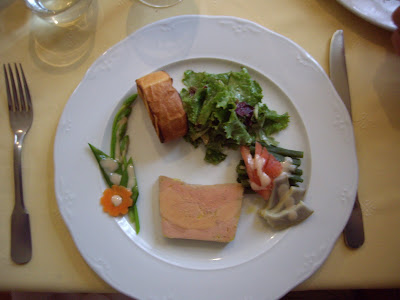

On another occasion this was my appatizer, a foie gras pate, a speciality in the Dordogne reigon of France. If you haven't tried it, don't knock it.


For the main course, Quail!

Now with all that, we better warm up the treadmill when we get home.


Wednesday, May 12, 2010

CARCASSONNE AND THE DORDOGNE

Our last day in Provence was May 8th a national holiday in France. They celebrate the end of WWII and every village, town and city, no matter what size, honor their fallen with a ceremony. It usually involves a band with the local officials making a speech and laying flowers at the war memorial that each community has. We were in small villages with less that 100 people and each had a memorial statute honoring the dead from both WWI and II.


V.E. DAY CELEBRATION

While driving along we came upon this celebration in a small town, which the name I do not remember. Each organization would lay flowers at the monument and then the children would lay their flowers, after which the French National Anthem was played.


You can see by the umbrellas, that it's raining, something that's been occurring more often than not.


We next headed to Carcassone, primarily to see the walled city there. On our way to our B&B we crossed the Canal Du Midi and observed this American Flagged canal boat. It is a popular vacation in these parts to rent a boat and cruise the canal.

http://en.wikipedia.org/wiki.canal_du_midi


While visiting Carcassonne we stayed a a very nice B&B in Cabrespine, a very small village in the local mountains. We were greeted by Elizabeth, who speaks very little English. With our hand jesters and the use of a French/English dictionary we were able to communicate enough to learn about here home. The house, which is three stories has been in her husbands family since 1850. In more recent times it was used as their vacation home, but 5 years ago Elizabeth and her husband moved into the 3rd floor and converted the 2nd floor into individual rooms for the B&B. Breakfast was on the 1st floor where there was a very nice living room to relax in. The rooms were filled with antiques and old photos of the family. It was interesting to see a family photo taken in the late 1800's in front of the house, which looked the same today as it did then.


OUR ROOM AT L'OLIVETTE

We visited Carcassonne which is a walled medieval city on a hill overlooking the new city below. The wall is 3 km around and encircles the chateau and the city. The site of the city on the hilltop is very impressive with it's guard towers and high walls. The city part of the interior is less impressive as it is full of shops selling basically junk and restaurants with over priced food. Plastic swords, miniature knights, and the same kind of crap you see at just about any tourist site in the states. OK for the kids, but boring for us. The tour of the chateau was OK, but the interior was devoid of furniture of the era.
Afterwards we went to the new city down below (old by our standard) and wandered the narrow streets. Much more interesting,


THE WALLED CITY

LE RELAIS DU PECH

We next moved on to the Dordogne, a region in France filled with hilltop chateaus overlooking the Dordogne River Valley. The area is a lush green and famous for it's caverns, both geological and prehistoric, the latter with cave paintings dating back thousands of years. We are at a B&B owned by Ken and Linda, who after retiring in England, relocated here in the village of Carlux. It's nice to speak to someone who has a good grasp of the English language, but they do sound funny with that accent and all. It turns out Ken retired at about the same time I did and from the same profession. They are both a wealth of information about the area and very friendly. They can accommodate 7 people in their three rooms and have plans to expand their business with a Gite, an apartment for longer term rentals. I keep forgetting to ask for the translation of the name of their establishment, but when I find out, I'll let you know.
We're still having problems with the weather, but as with everyone we meet, Ken and Linda also tell us we should have been here yesterday.

VIEW OF THE DORDOGNE VALLEY

It may be hard to tell in this photograph, but there are three chateaus on the right side of the river. Around every bend there appears another, some very large, others smaller, but all a sight to see.

THE CHATEAU AT BEYNAC-ET-CAZENAC

After a great lunch and after the rain stopped we climbed the cobblestone streets to the chateau. We did not take the tour, as there are just too many chateau tours in the area. The view from the top overlooked the valley and the river below.


CHATEAU AT LA ROQUE-GAGEAC
The is one of the many chateau that are occupied by the owners and not open to the public.