Wednesday, June 23, 2010

FACTS AND FIGURES

Well, we made it home on June 9th and we've taken stock of all that we experienced on this our latest adventure. Overall we had a good time and even with the rain we returned home with new and lasting memories. We made new friends in Ken and Linda, and spent four wonderful days with old friends Hansjoerg, Silke and Frank. Cathie made a special connection with Silke's mom, Ilse and they were both in tears when we said our goodbys.

For my final post for this adventure I thought I would share with you some of the facts and figures that were amassed on our journey. So here goes.....

Trip Prep time - I started planning this trip when we returned from Europe in 2006.

Money spent on stuff before we left home - Not as much as last time, but more than necessary.

Total days - 42

Airfare - Free, had enough points on the credit card.

How many points? - 110,000

Car lease - $1500
New Peugeot with full insurance and no deductible. (No dents or scratches)
Miles driven - 7200 km or 4320 miles
Mileage - 50 MPG
Cost per gallon of diesel - Around $5 - but figure the mileage, and it mile than in the states.

Traffic laws broken - Too many to count.
Tickets issued - None. Where's a cop when you need one.

Arguments with Alice - Actually we got along pretty well, but when there was a dispute on which way to turn, she was usually wrong, even though I was glad she came along. We would still be looking for our first B&B without her.

Amount budgeted - $200 a day, excluding car lease.
Amount spent - $153 a day.

Least expensive lodging - $45 B&B in Mauthausen, Austria
Most expensive - $112 - One night in a hotel somewhere in central France.
Although not a bad room, it was probably the worst one of the entire trip.

Best B&B - Can't answer this one as they were all great with just a couple in the just OK
category.

Best Food - It was all good and plentiful with the exception of anchovies in Cathie's salad.
Favorite Food - confit de canard and foie gras.

In 2006, customs took away my foie gras, this time they let me keep it.

Weight Gained - Dana, 7 lbs. Cathie, It's not polite to ask a lady.

Hours spent on airplanes - Too many (27 hours)

Flight delays - One, 2.5 hours delay leaving Geneva causing us to miss our connection in Washington. Still managed to get home just 2 hours behind schedule.

Days of sunshine - About 8

Days till the next trip to Europe - I don't know, but I've already started planning!


ON THE FINAL LEG

Thursday, June 10, 2010

SAVING THE BEST FOR LAST
WHAT A GREAT PLACE TO STAY

After Baden-Baden we headed through the Black Forest towards the small town of Zell im Wiesental. Why would we go to a little town that no one has ever heard of? That’s where our German friends, Hansjoerg and Silke live, and we saved the best part of our trip for last. To top it off it wasn’t raining!

Hansjorg had sent me an e-mail describing the scenic route from Baden-Baden through the Black Forest, so we programmed Alice and headed south. We’re glad we followed Hansjoerg’s instructions as the route he selected for us was beautiful. Following ridge tops most of the way, we had spectacular views on both sides of the road. After a leisurely drive, we arrived in Zell, as the locals call it, a little after 5 pm.

We were under the impression that we would be staying at Silke’s house, but when we arrived, we were told other arraignments had been made for us as Silke’s place was too small. After a welcoming bottle of champagne over which we caught up on old times, we were taken to a neighboring village of Pfaffenburg, about 4 km away. There Silke and Hansjoerg had arranged for us to stay in a wonderful guesthouse with an unmatched view. From our small suite on the top floor, we had a beautiful Black Forest view with a small church situated far below. Perfect! We were treated to a great dinner at the Berggasthof Schliissel, our home for the next four days. The owner, Monica attended to our every need as we had a long and quiet evening with Hansjoerg, Silke, Hansjorg’s son Frank, and Silke’s mother, Ilse. The food was excellent and the wine plentiful.

The next morning Hansjoerg, Frank, Cathie and I, took a hike in the Black Forest, led by Hansjoerg, who assured us that he knew the way. After a 6 mile trek, we weren’t to sure, but it was well worth the effort with a stop along the way at a guesthouse serving some great German fare. To get back down the mountain, a ride on a summer toboggan was in store. More like a one man rollercoaster at 2.9 km, or 1-3/4 miles long, it is the longest summer toboggan in Germany. What a ride. Check out their website.


We capped off the day with a great meal at Silke’s prepared by her and her mother. Joining us in addition to those already mentioned was Hansjoerg’s daughter Bergit. Both Frank and Bergit in their early 20’s seem well on their way to successful lives and both were a welcome addition to the evening.

Cathie enjoys a German invention called “Radler”’ which is beer and lemon soda. You can buy it bottled, and our friends made sure there was plenty on hand. We had a great evening with Bar-B-Q German style, more than enough food for all with lots left over. On the back patio with the sun setting over the hill, you couldn’t ask for a better evening.

The next day we headed to an old village where there was a craft fair, along with some depictions of how things were done back when. One old house from the 1800’s has been preserved and turned into a museum. Interesting stuff. Having been worn out by Hansjoerg’s trail blazing abilities the day before, he led us on a short walk to a waterfall, before ending the afternoon at another guesthouse for refreshment. Because of some rain (yes rain) and evening thunderstorms in the forecast, we had another great dinner at Berggasthof Schliissel,

The next day, Cathie took the day off and Silke had to go back to work, so Hansjoerg and I spent the day wandering around Basel, Switzerland, which is just a few minutes away for Zell. Another great evening was spent on the patio at Silkes’ with more great German cooking.

We were treated like royalty by our hosts. They showered us with kindness, not to mention gifts, and wouldn’t let us take our wallets out of our pockets. On more than one occasion when I tried to pay, the proprietor wouldn’t allow it, having been told in the native tongue that our money was no good. After 3 days and 4 nights it came time to say good-by. It was difficult leaving after being entertained on a grand scale by Hansjoerg, Silke, and Ilse. We all promised that we would see each other again in the future and I sure we will. Good friends like these are hard to find.
BREAKFAST ON THE TERRACE
There are Guesthouses all over Germany and they all serve breakfast with the price of a room. Our guesthouse was full over the weekend with a wedding and lots of bikers. (not the outlaw kind) There are also guesthouse in the hills where one stops on a hike or mountian bike ride for a place to stay or a meal.

THE VIEW FROM OUR BALCONY
We couldn't get over how green everthing is. The rain helps, but it stays this was most of the year, only changing when covered with snow.
THE HIKE


MORE REFRESHMENT
This is the place we stopped for lunch and drink on our hike. It's very common to find such places on the many hiking trails all over Germany.

FRANK AND BERGIT


THERE'S ALWAYS TIME FOR SHOPPING


GREAT FOOD, GOOD FRIENDS


Thursday, June 03, 2010

BADEN-BADEN

It rained while getting here, but since arriving in Baden-Baden no rain, but plenty of water. If you don't live here, you come to Baden-Baden for just a few reasons. To spend lots of money at the high end shops in the pedestrian zone, or to spend lots of money in the casino or to go to one of the spas. Since one of the goals of this trip is not to break the bank, we came for the latter. Any town with "Bad" in it's name, has a spa. They are all over Germany. Since this towns name is repeated, I guess you could say it's spa is something special.


THE FRIEDRICHBAD

On a recent trip to Germany, friends Mike and Nancy told us about the spa at Baden-Baden. They gave us a rundown on what it was like and said is was the one of the highlights of their trip. You go through 17 different stations involving water, heat, and cold. Men on one side and women on another. In the middle men and women meet in the thermal therapy pool. On certain days, men and women share all the facilities, on others the sexes are separated. On holidays, it is co-ed. Why must you know this? Because the spa is not a clothing optional zone. Clothing is not allowed. So we made sure were we there on a Thursday, a day the sexes are separated, except in the therapy pool.

Well as the saying goes, "the best laid plans..." It turns out Thursday was a holiday in Germany. Cathie said no, I said yes, so having come all this way, I wasn't going to miss the experience. With Cathie safe in our hotel room, I went local. Nudity here is no big thing. In the summer people in the parks of Munich sunbath topless and no one bats an eye. Going to a spa is just part of life here and it's considered therapeutic.

The following is from the spa's brochure:

On opening in 1877, Friedrichsbad was considered to be one of most beautiful bath houses in Europe. When you enter, you immediately get a sense of the history, culture and atmosphere of over 130 years of bathing tradition. Take a step back in time and enjoy the unique beneficial effect of the Roman bathing culture, combined with Irish hot air baths. The temperature changes are deliberately coordinated to be beneficial; after a sharp increase at the beginning, the temperature gently drops until the cold water immersion bath. Who can resist!

Here's how it went. Pay your fee and decide if you want what is termed a "soap-brush massage". Mike told me, do it as it's part of the experience, but he added, "it hurts". So I passed. You change into your birthday suit, and take from your locker a sheet, which turns out is your towel. At each station, there are instructions on the wall, in English, telling you how long to stay in that particular room. My first mistake was leaving my glasses in the locker. At the first station, the shower, there is an attendant stationed to get you started. So you spend 5 minutes under a shower of copious amounts of water. After a good dousing, you go to the "warm air bath". It's then you discover that the sheet is not for covering you up, but to lay upon on the very hot wood tables in the sauna where the temperature is a balmy 129 degrees. I think the sign said 15 minutes. Next, it's the "hot air bath" and you ask yourself, what did I just have. Then you find out what hot is. 154 degrees for 5 minutes, I think.

Not knowing if I was getting the times right, I figured I'll just follow someone and hope they don't need glasses. This worked for a while, but I think the person I chose to follow was into torture. Next you get to shower again before heading to the steam baths, 113 and 118 degrees, after which you start to cool down in the thermal whirlpool and therapy pools. The latter is under a huge domed room done in the the roman style. Next it's another shower before the cold water immersion bath at 64 degrees, which after what you just experienced feels like 30 degrees.

Next you get a warm towel to dry off before going to the cream service room, where if you choose, you can rub various lotions on you body. Hey, I paid for it, I'm doing it. Lastly the relaxation room for 30 minutes. Here you lay on a table and the attendant wraps you in a warm sheet and blanket and you enjoy the warmth and complete silence. It's then that you really relax.

The whole thing takes about 2.5 hours and you never have felt so relaxed and clean, until you have to put on your dirty socks and underwear. Was it worth it? You bet. Did I feel uncomfortable? Only for the first 5 minutes when I didn't know what to do with the sheet. Would I do it again? Why not?

BADEN-BADEN


RIVERSIDE WALK


Baden-Baden has a really nice parking running through the middle of the city. It's a couple of miles long and a great place to stroll after your bathing experience.
THE PEDESTRIAN ZONE

Cathie's always making new friends. Could this be Claus?
From here we head to the Black Forest for several days with our friends, Hans and Silke, the German couple we met in Utah last year. At that it's back to Geneva for our flight home next week.


Wednesday, June 02, 2010

WHAT THEY DO BETTER

One of things I've noticed while traveling around Europe, both on this trip and when we went in 2006, is that they do a lot of things better than we do. That's not to say we Americans don't get it right most of the time, we do, but we could learn a few things from the people across the pond. So I thought I would make a list, in no particular order of importance, just put it on paper as it comes to mind.


Cashiers at the grocery stores sit down.


You bag your own groceries in your own bag, or buy one, even the cheap throwaway plastic ones.


You must deposit .50 to get a grocery cart, you get it back when you return it to the covered cart spot. Carts are dry when it rains and not scattered all over the parking lot. They are not in the neighborhoods either.


Many busy intersections have a traffic circle, no signals, traffic seems to flow pretty well with no delay waiting for a green light. Also no one runs a red light, there are none.


In Germany and Austria on the autobahns, there are periodic electronic maximum speed signs that can be changed for traffic and weather conditions.


Also on the autobahns, unless you're passing, you stay in the right lane.


People actually signal when making a lane change.
Most cars run on diesel and get great mileage. Our lease car gets over 50 MPG


When you make a reservation at a B&B, your word is the only guarantee required.


You pay in cash when you leave, not when you arrive.


The same for many hotels, room charges included, with no credit card number.


Breakfast is almost always included in hotels and guesthouses.


In France, when you pay a restaurant bill with a credit, card, they bring the card reader to your table. The card never leaves your sight. In Germany the waiter goes over the bill with you.


You pump, before you pay.


In France, Germany, and Austria, the tip in included in the cost of the meal. You can leave a small amount if the service was especially good, but it's not expected. When you see the price of an item on the menu, that's the total price, tax and tip.


In France it's the law, in other places they do it too, the menu is posted on the outside of the restaurant.


When you get a table, it's yours as long as you want it, no one is rushing you. In fact in France, you may think the waiter is ignoring you. You have to ask for the bill.


Wine and beer are cheap. A six pack in a German market can go for as little as $2. and that's German beer.


California wine in the grocery store is cheaper here than at home with the exception of Two Buck Chuck, which I haven't seen here.


When you order the house wine in a restaurant, you'll usually get a good regional wine.


In France there are speed cameras. First you see a sign telling you of the camera ahead. Next a sign reminding you of the speed, then comes the camera. If you get your photo taken, you're stupid or just not paying attention. If the if either is the case, let someone else drive.


Just about every town of any size, has a tourist office.


In Germany on the autobahn, there are numerous rest stops. The bathrooms suck, unless...


At German autobahn plazas, rest stops with gas, restaurants, and sometimes hotels, the restrooms are very clean, but you pay .50 at a turnstile.


You want a clean restroom? Go to one that you pay a small fee for. The toilet seat gets cleaned and dried automatically with each flush.


The French know how to make bread.
Most people speak some English, just about all young people do.
That's all I can think of but I'm sure there's more. Perhaps one day I'll list what Europeans do poorly.


Monday, May 31, 2010

IT'S NOT RAINING......... IT'S SNOWING!

The weather is changing and not for the better. It's been snowing, with accumulations at the higher elevations. Figuring to stay dry, we headed out for a drive to check out the surrounding area. From the valley below our B&B, you can drive up different valleys in all directions. On many of the roads that go nowhere except to some isolated spot, there is a toll, usually under 10 euros. I believe the toll helps pay for road maintenance and for upkeep of the many hiking trails. When they're not skiing, they're hiking. Everybody seems to do it, young and old, rain or shine or snow as the case may be. We drove up this narrow valley for about 15 miles and ogled at all the waterfalls cascading down both sides. At the end of the road, we came upon this little guesthouse with a small restaurant. We ventured in and took a seat in the corner. With cowbells hanging from the rafters, and musical instruments standing in the corner, we figured it wouldn't be long before a Tirolean mountain climber came down from the high country and began yodeling. Such was not the case.
The fair is simple, sausages and potatoes. Lots of cows in the neighborhood, so they have fresh buttermilk, which is kept cold in a water trouth outside. I found out about the buttermilk after ordering my wine, so I'll have to try it another time. I keep ordering the wrong sausage and ending up with something that looks suspiciously like a hot dog. Tastes like one too.


This is our B&B here in the Tirolean Alps, about 50 miles from Innsbruck. We have a small one bedroom apartment. It is located on the very steep side of a valley in a ski resort area. The road up to the house is very pretty. Pretty narrow, pretty steep and pretty scary. If you build a house on a slope this steep in California, it would soon be at the bottom of the hill. It's location affords some really great views from high above the town. The apartment has views on three sides of the house, with two balconies and a patio. Great digs, so we're staying for three nights.


HERE'S THE VIEW


Since we can't fight the weather and we are in a ski resort, why not take some ski lessons. After some urging, Cathie agreed and after meeting our ski instructor, Claus, she thought skiing was the best idea of the trip. We took the cable gondola to the ski area and it was like a winter wonderland. All our equipment and clothing were included in the instruction package, and with Claus in the lead, what could go wrong. I think from the attention Cathie was getting, she wouldn't care if she did break something. Anyway, on the bunny slope we went and after much falling down, we actually stood upright and skied, at least for a short distance. No photos, though, much too busy keeping an eye on Claus.

If you come to Europe to see art, and you're too cheap to pay the entrance fee for the art museum, then go to a church. The art work and decoration in just about every church in this part of the world is unbelievable. Some of it by famous artist, most all of it religious. From paintings, statues, wood carvings, murals and just about every other art form, is found in the churches. Even some of the smallest villages have great works in their churches. In an upcoming post, I'll submit some of the numerous photos I've taken of the subject.

This church is in Hall in Tirol, Austria. The alter is canted off the main part of the church for some unknown reason. The alter is covered in gold and the pipe organ stands out if you turn around and look toward the back of the church.

While taking these photos, a gentlemen asked first in German, then in English if I knew why the alter was positioned so. I didn't and neither did he. He did tell me that this church was for the people with money as evidenced by all the gold and silver. He said the church for the poor people was in Swartz, the next town down the road and not so lavishly decorated.


If you belive the part of this post about the sking, you'll beleive anything.

Saturday, May 29, 2010

BERCHTESGADEN AND VICINITY

GROSSGLOCKNER ALPINE ROAD

CURVES


This is really a beautiful part of the world, too bad it's raining. Seems like the theme of our trip is to see how many places we can go where it' raining. It's somewhat depressing as we change plans because of it. When we arrived in Berchtesgaden, the weather report said the next day would be the only day without rain this week. There were two places we wanted to see which are best without the rain, so we had to choose one. It was either Hitler's Eagles Nest, best seen when the mountain is not covered in clouds, and the Glossglockner Pass, also best in clear weather. Because bus loads of tourist crowd Eagles Nests, we opted for the Glossglockner.


The Glossglockner High Alpine Road ascends to an altitude of 8215 feet while covering 48 kilometers with 36 hairpin turns. The bends are number so the speeding motorcyclist can keep track of how much longer they have to hang on. It's is a really fun road to drive with spectacular views around every one of those scary hairpin turns. At times it can be crowed with motorcycles not to mention very large tour buses that manage to crawl their way up the mountain. At the end of the road you are greeted with a view of the Glossglockner Glacier. The drive's not free though, they charge you 28 euros ($34) for the privilege, but you can drive it as many times as you want in a day.


MARIA GERN CHURCH


OUR B&B


VIEW FROM THE BALCONY
We we arrived in Berchtesgaden, in the rain I might add, we stopped by the tourist office and got a list of potential B&B's. We ended up at Haus Michael in a nice size room with a great view from the balcony. Although is was cold, it was nice to sit on the balcony with our wine and beer and watch the clouds roll up the valley.
A word about food in Germany. There's lots of it and much of it consists of pork, potatoes, sour kraut, great soups, spatzle a potato base noodle and sausages. They've also got this dumpling that comes with some dishes that has the consistency of paste, so opt of the bread dumpling, it's much better. Good food and huge portions. For breakfast besides the usual juice and coffee, there's rolls, bread, yogurt, cereal, cheese, meat in the form of cold cuts, yes cold cuts for breakfast, and a soft or hard boiled egg. It's hard boiled if you arrive late. Anyway it's a whole lot of food.
Today we moved back to Austria and on the way we stopped for our main meal at a restaurant in Hall in Tirol. So here we are in Austria, eating at an Italian restaurant, having French onion soup, German spatzle with cheese and California wine. Go figure!

Friday, May 28, 2010

SIGNS

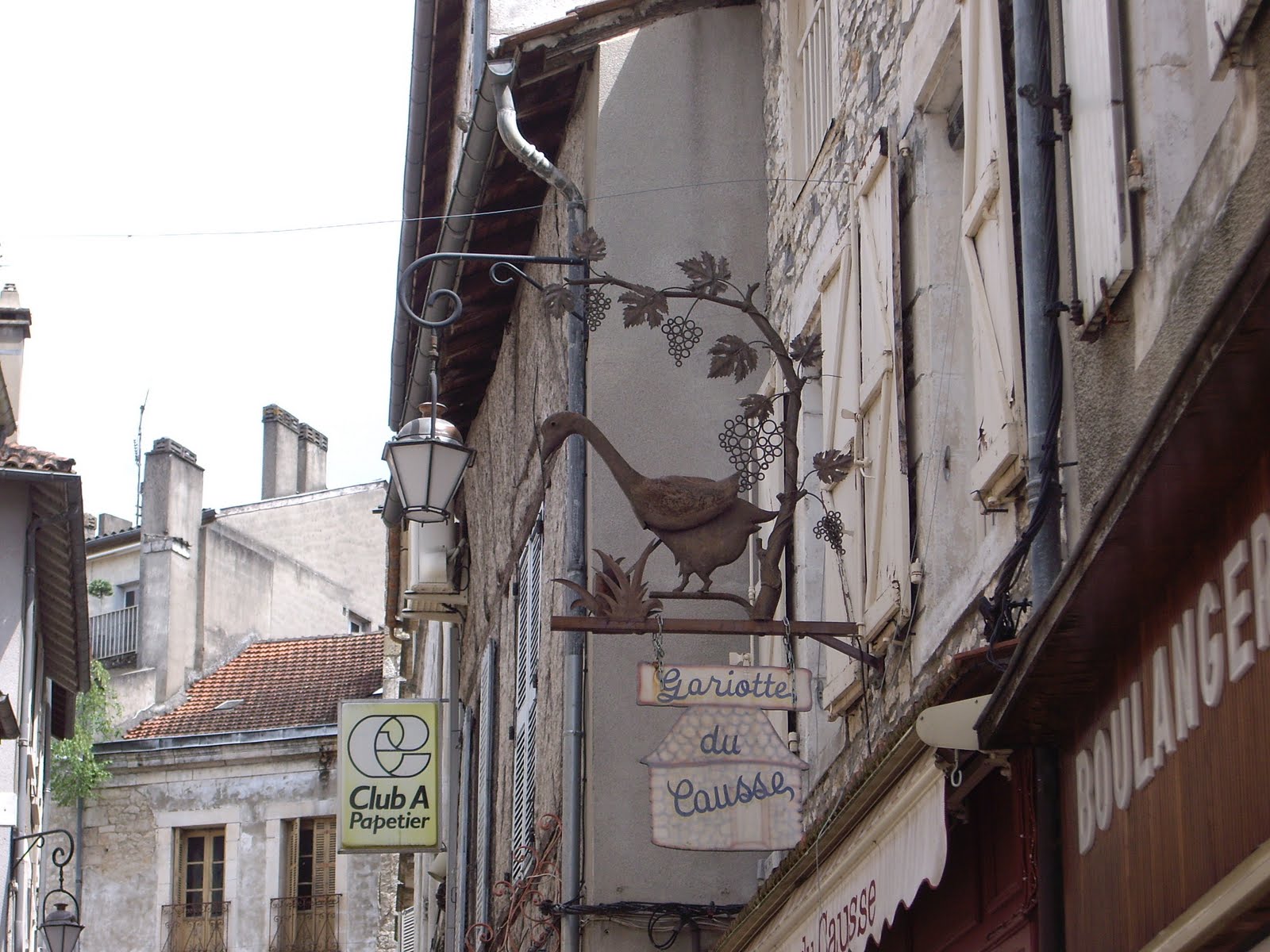
All over France and Germany are signs over the entrance of bossiness made out of wrought iron depicting in it's form the type of business. Some are pretty straight forward letting you know the type of business. Some are more difficult to understand. For instance, a sign with a stagecoach usually means it's a hotel. This one below has a stagecoach, but it's hard to figure out why the big fish is trying to eat someone. Some are comical, but they all have some meaning and are everywhere in the older parts of cities and towns. Enjoy the photos. See how many you can guess right.


IT CERTAINLY IS


Thursday, May 27, 2010

A GREAT TOUR A SOMBER TOUR

REGENSBURG

I had read on several occasions about taking a tour of either a Mercedes or BMW factory while in Germany. Months ago while checking out the possibility, I discovered a appointment was required for one of the limited spots available on an English speaking tour. So about 5 months ago I made an appointment for the tour of the BMW plant in Regensburg, Germany.

We arrived a the appointed hour and at the specified location and right on time we were met by Franz, our guide. There were only three other people on the tour with us, and after introductions we were given a short safety briefing and watched a short film on the history of the company.

I've been on the tour of the Ford truck factory in Detroit. This is nothing like the one there. Ford is so worried about liability, that you walk on catwalks above just one assembly line. At BMW, they give you safety glasses and you get right down on the assembly floor. I know it's a guy thing, but it's quite impressive. You are constantly dodging fork lifts, and automatically controlled vehicles shuttling parts. You see the giant presses, mostly operated by robots which stamp out the body parts. The metal comes into the factory in giant rolls and comes out of the presses as doors and fenders. You get showered by sparks as the robots weld the parts together. If a defect is noted in the body, a dent or bad weld, the vehicle is scrapped and steel is sent back to the foundry.

You get to see the vehicle being painted and then assembled, with the body and chassis coming together towards the end. We spent 2.5 hours walking 3.5 kilometers on the tour and I at least enjoyed it all. I would recommended this tour for all us guys. Now I want to buy a BMW. Anybody want to give me a loan?
MAUTHAUSEN CONCENTRATION CAMP

After leaving Regensburg we drove on the autobahn (lookout for fast cars and stay in the right lane) to Mauthausen, Austria a small town near Linz. We found a B&B just outside of town for 36 euros, or cheapest room yet. Nice simple room on the ground floor (converted garage) with a big flat screen TV and satellite. Most of the all of the other guest were men who were in the area for work, so the TV schedule included lots of X-rated material. On the downside it also had CNN and BBC.

We spent the better part of a day at Mauthausen Concentration Camp, just outside of town. This started out as a German POW camp for Russian and Polish prisoners of war, but over time political prisoners, Jews and various others made up the camp population. Next to this camp was a granite quarry and many prisoners died carrying heavy block of granite on their backs up what became know as the "Stairway of Death". From 1938 until liberated by U.S. Forces in May of 1945, over 200,000 people were deported to Mauthausen. Around 100,000 inmates died, some 10,000 in the gas chamber, with the majority of inmates dying through mistreatment and by being ruthlessly worked to death.
This camp is one of the few that still has many of the original buildings.


Sunday, May 23, 2010

SHOPPING

FRENCH SUPERMARKET

Shopping in Europe is an adventure all by its self. In France there are several large supermarket chains to choose from and they are somewhat different from those we have in the States. Carrefour and Intermarche are common as is, E.Leclerc, pronounced, la clair. They are pretty much the same and most have a department store section selling everything from clothes, to garden supplies. Most sell gas and diesel and have the cheapest price in France. Some other differences include, checkers who sit at the registers, bring your own shopping bag or buy one at the store, and bag your own groceries. Most will have an extensive and separate departments for meat, cheese and fish. There is a wide selection, which at times for us was daunting just trying to figure out what was in some of the different packaging.

SHOPPING CARTS

When you arrive in the parking lot, pick up your cart by putting a .50 coin in the slot which releases it from the next cart. When you return it, you get your .50 back. You never see abandoned shopping carts in the neighborhoods as you do at home.


SUPERMARKET BUTCHER COUNTER

SALAD AND DESSERT COUNTER

Some of the larger markets include other stores, restaurants and bars. In Germany, Wal Mart has a beer garden. We encountered several with large cafeterias. I was seated next to this large display of salads and desserts at one such cafeteria. I grabbed this picture during a lull of customers. While taking the photo I noticed one women customer giving me the evil eye. Several minutes later, I had been reported to the management and was contacted by one of the employees who wanted to know what I was doing photographing the food. The employee, a cook, perhaps thought I was stealing trade secrets for the competition. I tried to explain my purpose and thinking I was making headway I asked if I could photograph him cooking. At this point he must have thought I was completely crazy and told me "It is not permitted". He left at this point, but kept an wary eye on the strange American, while I finished my coffee.


When you buy fruit and vegetables at the grocery store, you bag them, place them on the scale in the produce department, push the appropriate pictured button and a sticker with the price and bar code is printed. This gets scanned at the cash register. At the cheese counter, the cheese is not only sold pre cut a packages, buy you can select an amount to be sliced from a large round of cheese.

CHEESE COUNTER AT L.LECLERC

The following photographs were taken at one of the many town square marketplaces. Most every town and small village in France have a weekly market, and in some larger towns these markets take place twice a week. Food is locally produced and of a wide variety. For the most part, the supermarket is cheaper.

SAUSAGES


THE BAKER


LOTS OF OLIVES


THE SPICE VENDOR


FRESH FISH


DESSERT


There's another kind of shopping. It's the kind one does while on a trip because she realizes she doesn't have enough clothes. Without any consideration on how more items will fit in the carry on, one must shop. You manage to get a great selection in the tourist shops along side the plastic swords, miniature figurines, Christmas ornaments, T-shirts that say "all grandma got me was this lousily T-shirt", and Harley Davidson memorabilia. (The latter is quite popular here in Germany).
On a recent such outing, I was at my usual post outside of the store enjoying the scenery, and I made this observation. Of the four stores of similar type, one each corner, all four had a gentleman about my age, standing outside enjoying the scenery. Goes to show you things are pretty much the same everywhere.