Thursday, April 05, 2012

CHULA VISTA TRASH

About 3 days a week I ride my bike from our house to the Coronado Ferry Landing and back.  Some of the ride is on a designated bike path and some in bike lanes on surface streets.  Most of what I ride on is part of The Bayshore Bikeway, a route around the San Diego Bay.  My route passes through,  an unincorporated area of San Diego County and the Cities of National City, Chula Vista, San Diego, Imperial Beach and Coronado.  Below is a nice new portion of the path in Chula Vista.


It's nice and clean now, but just wait and it will soon be trashed.  The graffiti has already started and this new section has only been open a couple of weeks.  But lets talk trash.

Now as you ride along various sections of the Bikeway, you see the usual trash which people discard out of car windows.  You know, paper cups, cigarette butts, cans and bottles, diapers, and pieces of paper.  But in the City of Chula Vista it gets worse.  Did you know that "chula vista" is Spanish for cool view?  Well, it's not too cool.  Here's some of the views one gets as you ride along.


This nice couch has been here since around the first of the year, the mirror arrived later.  There was a bigger couch here, but somebody must have liked it because it has disappeared.


Here's a lovey couch/recliner that arrived in the past few days.


Now these two tree stumps will never grow again.  They were transplanted to this location BEFORE CHRISTMAS, they still haven't sprouted any new growth.


Mattresses are pretty common along the roadway.  This one's pretty recent.


Now these articles have been here for about 5 MONTHS that I can remember.  That's like LAST YEAR!  Part of a recliner, a mattress, and other junk.


We have here a matching box spring and mattress.  These two items have also been here since BEFORE CHRISTMAS.  Now last week they were together down in the ditch, but as you might have noticed one has been moved due to the city mowing the grass!


And finally we have this pile that has been here for over a year! 

Now you can't tell me that since this trash has been deposited along the street, some city employee hasn't seen it.  So I ask why haven't they picked it up yet?  Most of this stuff is in an area that was annexed by the city in the late 70's or early 80's, the city telling voters they could provide better services than the county.  So is this their example of better services?

This is just a small portion of the crap that is strewn along these streets.  Now you might ask why am I singling out the City of Chula Vista.  Well it's because that's where most of the trash is.  Yes, I understand that some idiot dumped this stuff and the City didn't.  But I can guarantee you that if this junk was dropped off in East Lake, a nicer area of town, you can bet the city crews would be picking it up pronto.

Now I'm going to be sending a link to this story to various Chula Vista city officials.  I'll let you know what happens.

Sunday, April 01, 2012

RACING ON ISLE RUN

Got a call the other day from my ol' sailing instructor Dave (old, not in age but in long time ago instructor) who asked if I wanted to crew for him in a race on Sunday.  In checking my schedule I had two choices, (1) get up at 5:30 am and ride my bike for 50 miles and be wiped out for the rest of the day or (2) sleep in till whenever, eat a leisurely breakfast, get to the yacht club by 11:00, sail till we crossed the finish line, drink beer.  I was really torn because I usually don't drink beer, but I decided to make an exception.  Also it should be noted that it was Dave and his crew on Isle Run who came in 1st two weeks ago in the NOOD and trounced us on the Sabbatical.  I figured I could pick up some pointers. (see previous entry).   I also was aware that Dave might be asking me to crew so he could find some inside information from a crew member of the Sabbatical.  It was an opportunity for me to perhaps provide him with some false scuttlebutt giving the Sabbatical an advantage for next year.

DAVE AT THE HELM

The race was to be 11 miles from start to finish and our closest competition was to get a huge head start.  Due to handicapping they got a full 21 minute head start and in order for us to beat them we had to pick up that 21 minutes plus cross the finish line a minute and a half ahead of them.  A tall order on a day with changing wind direction.  With a staggered start there was no confusion at the start line as the other boats in our class left before us.

RHONDA DOING HER JOB ON THE RAIL

Rhonda started sailing the same time I did and we both attended the same classes taught by Dave.  She knows more than I do for two reasons.  First, she paid better attention in class and second, her boyfriend Marvin is a really good sailor.  They sometimes sail with Cathie and I on Nice Aft.

 
DAVE AT THE HELM AND JOE ON THE JIB SHEET

Not shown in any of the photos is Brain, Dave's 1st mate and the most experienced sailor on board, besides Dave.  Anyway, with Dave in command at the helm and  Brian on the main guiding those of us with less experience we were off.  Out of Glorietta Bay into the main channel of San Diego Bay, under the Bay Bridge and north to Harbor Island.  Then it's a 180 back to the south, under the bridge and into South Bay before making another 180 and heading back into Glorietta Bay to the finish.  We figured we were doing pretty good until on the way south we passed our closest competition heading north.  They were still pretty far ahead of us and it looked like we probably wouldn't catch them.

 
ERNESTO AND CRIS WORKING FORWARD

Ernesto here is also very experienced as he is one of Dave's teaching assistants at Southwestern College.  Standing is Cris who serves our county in the navy, so he must know something about sailing.

FASTER CLASS HEADING DOWN WIND

Faster than us, the above boat is heading downwind with their spinnaker flying.  Their in the same race but in a different class than us, so it's ok for them to be ahead of us.

In the end the 1st place boat with the huge handicap finished 10 minutes ahead of us.  We came in a distant 2nd with other boats in our class never in contention.  We also managed to place 4th overall, so all in all not to shabby. 

Monday, March 19, 2012

DAYS AT THE RACES

Some of you may know that I have a Catalina 22 and enjoy sailing in San Diego Bay.  I am also on the race crew for Sabbatical, a Catalina 36.  I've been crewing for Larry, the Sabbatical's owner/captain for the past year and we have been pretty successful racing against others in our fleet.  We usually manage to pull out a first or at least finish near the top.  Once a year the National Ocean One Design  Regatta, commonly referred to as The NOOD (pronounced nude) comes to San Diego for a weekend of racing.  This is a really big deal in the sailing world with 141 boats entered in 17 different classes.  Races are held, offshore, in San Diego Bay and Mission Bay.  Our class of Catalina 36s'was in for 5 offshore races with three on Saturday and two on Sunday.

Weather became a issue with a rather large cold front heading our way.  With the forecast for 30+knot winds and 10 to 20 foot seas, the race officials cancelled all offshore races and moved them inside the bay.  Even with that the winds were steady at right around 30 knots with gusts to 40.  Larry said we're going, so we suited up in our foul weather gear and got the boat ready.


To give you an idea of what winds of 20 knots are like, here is a video of a Catalina 36 in Puget Sound.  Keep in mind that winds in San Diego Bay for our races were clocked as high as 40 knots!


With all the boats inside the bay, it gets pretty crowded at the start.


In the first race we are the last class to start as the Catalinas are the slowest.  There were four starts ahead of us at 5 minutes intervels.  Race signals are horns sounded from the race committee boat and with warning horns leading up to the actual signal to start.  If you cross the start line before the horn, you must go back and cross again.  Well, we were way off on our timing and confused at which horn had sounded.  We actually started on the one minute warning and didn't realize our mistake.  So we were off, ahead of everyone.  Even if you subtract our one minute head start, we were actually faster than most of our fleet and crossed the finish line first.  But because we screwed up we were scored in last place.

With the weather getting worst and visibility down to just a couple of hundred yards, the rest of the races were cancelled for the day.  We were cold, wet, tried and dejected.  We knew we had to do better on Sunday and not make any mistakes. 


Sunday morning the weather had changed, mostly for the worst.  The rain was scattered and included hail.  The offshore swells were higher than Saturday and the wind was still howling.  Another great day for racing.  In the first race we timed our crossing of the start line to the second, along with several others.  We could have passed beer between the crews we were so close.  We fared better and finished in 3rd.

In the second race we managed to squeek by and take 2nd place.  While racing we clocked a wind gust at 40 knots.  With winds like those the skipper is always fighting to keep the boat going in a straight line.  When healing over in strong winds, more of the boat's hull is in the water.  The more upright the boat is means less hull surface in the water, thus less drag and more speed.  That's why you see crew sitting on the side of the boat with legs hanging over.  Those crew members are called "rail meat".  So when you're not tacking or trimming sails as many of the crew as possible become rail meat.  And I did a mighty fine job too.   


When all was said and done and the scores were tallied, we ended up in 4th place overall.  You might say that, "well that's no too bad considering", but since there were only 5 boats in our class, 4th is the same as "next to last".

For me, this was the first time I sailed in these conditions and I managed not to fall overboard.  Cold, wet and tried but it was pretty exciting.  Next year there won't be any mistakes and we'll get our pride back. 

Hear's a great Photo of Sabbatical coming at you.

Tuesday, March 13, 2012

BELIZE - THE FINAL CHAPTER

Because I'm experiencing writers block, plus the fact that most of you are most likely getting bored, this will be the last entry about our Belize trip.  Lots of photos and some about what we did.

We went on a second norkeling adventure, this time with Avadon Divers out to the Barrier Reef.  The Belize Barrier Reef is second only to the Great Barrier Reef in Australia in size.  From Placencia it's a 25 mile boat ride out to the reef taking a little over an hour.  There were three other customers on the boat who were going to be SCUBA diving.  Once we arrived at the reef the divers were put in the water on the ocean side of the reef.  The boat then moved to the other side where we were put in the water.  With our guide, we swam along the reef at a depth of around 15 to 20 feet for about an hour.  The fish here were much more plentiful and the water much clearer than our first excursion to Laughing Bird Caye.  We saw a huge stingray and so many colorful fish, I can't remember them all.. After about an hour the boat came, picked us up and took us to our second spot near a small island.  We were put in the water on the windward side and I immediately saw two very large Spotted Eagle Rays swimming peacefully along the bottom.  It was a sight to behold.


We swam around the island to the leeward side we were were once again picked up by our boat.  After our second snorkel we made a stop at South Water Caye for a potty break before heading back to the mainland.

South Water Caye is a 12 acre island on the barrier reef that for a price, and high price I might add, you may stay in one of the small resorts.  A very beautiful setting.  


SOUTH WATER CAYE

Of course every trip requires eating at the local establishments.  Overall we had some great food and in large quantities  The helpings in most restaurants were huge as evidenced by our collective weight gain, which we won't discuss further.  Only one bad experience.  Although the food was good, the service was extremely slow at Wendys Creol Restaurant.  Seemed like they prepared the food for one table at a time.  Took over an hour for our meal to arrive.  To top it off, when I got home and checked my Visa statement, they charged me twice for the dinner.  Won't be going there on our next visit.


DINNER AT THE SECRET GARDEN

LUNCH AT LAUGHING BIRD CAYE

DE TATCH CAFE, ONE OF OUR FAVORITES

THIS IS WHAT A BILLION CALORIES LOOK LIKE
STUFFED FRY JACK FOR BREAKFAST

THIS IS AS CLOSE A CATHIE GOT
TO EATING A LOBSTER


Although we had a kitchen with all the utensils, we really didn't use it much.  Coffee and toast in the morning and chips and salsa in the afternoon.  Our excuse was that there was only room in the refrigerator for beer.  We did try for some healthy alternatives.

CATHIE AND HER WATERMELON

GARY AND CATHIE AT THE PRODUCE STAND

We had two days of rain but it really didn't bother us.  We still managed to enjoy ourselves and stay dry for the most part.

THE COWS KNEW WHEN TO COME OUT OF THE RAIN

I snapped this picture from a bridge overlooking this river.  Right after capturing this image, the ladies gave me the one finger salute.  I guess they weren't to happy.  Sorry ladies.

LAUNDRY DAY


The beaches in Placencia were really clean but much of the surrounding areas were not.  Lots of trash along the roadways and in the smaller villages.  Just kind of junky looking.


Are there bugs in Belize?  You betcha and just about every one of them found Gary.  They really loved the taste of his blood.  Cathie and Diane got bit a couple of time, and me?  Not once.  Besides the mosquitoes, there are sand flys and the bothersome, noseeums which are not stopped by screens over the windows.  Bring lots of Deet, which I only had to use on my visit to the wildlife sanctuary.  A good item to bring is a product called "After Bite" available at REI.  It takes away the itch and really works. Gary used a whole bunch.

PERHAPS HIS WHITE LEGS ATTRACTED THEM!

We heard they had something at the local pharmacy that prevented the bug bites, but the day we found this out was election day and the shop was closed.


TYPICAL HOME IN BELIZE

Lots of buildings had these roofs covered with palm fronds.  They are tightly woven together and really keep the water out.  We were told that the roof lasts for 12 years or so before having to be replaced.


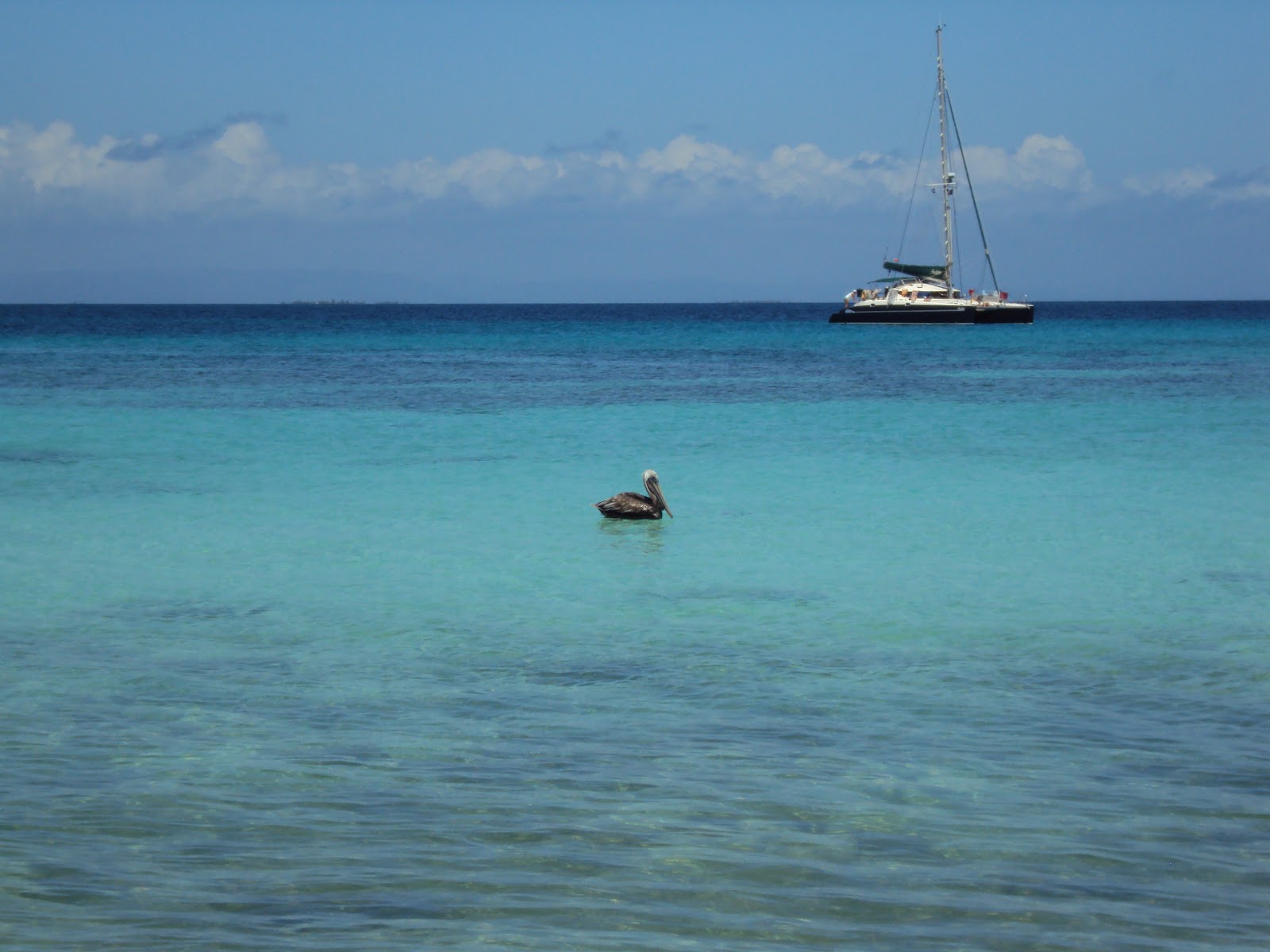
Pelicans feeding on our beach in the morning.


 HEADING BACK TO BELIZE CITY ALONG
THE HUMMINGBIRD HIGHWAY

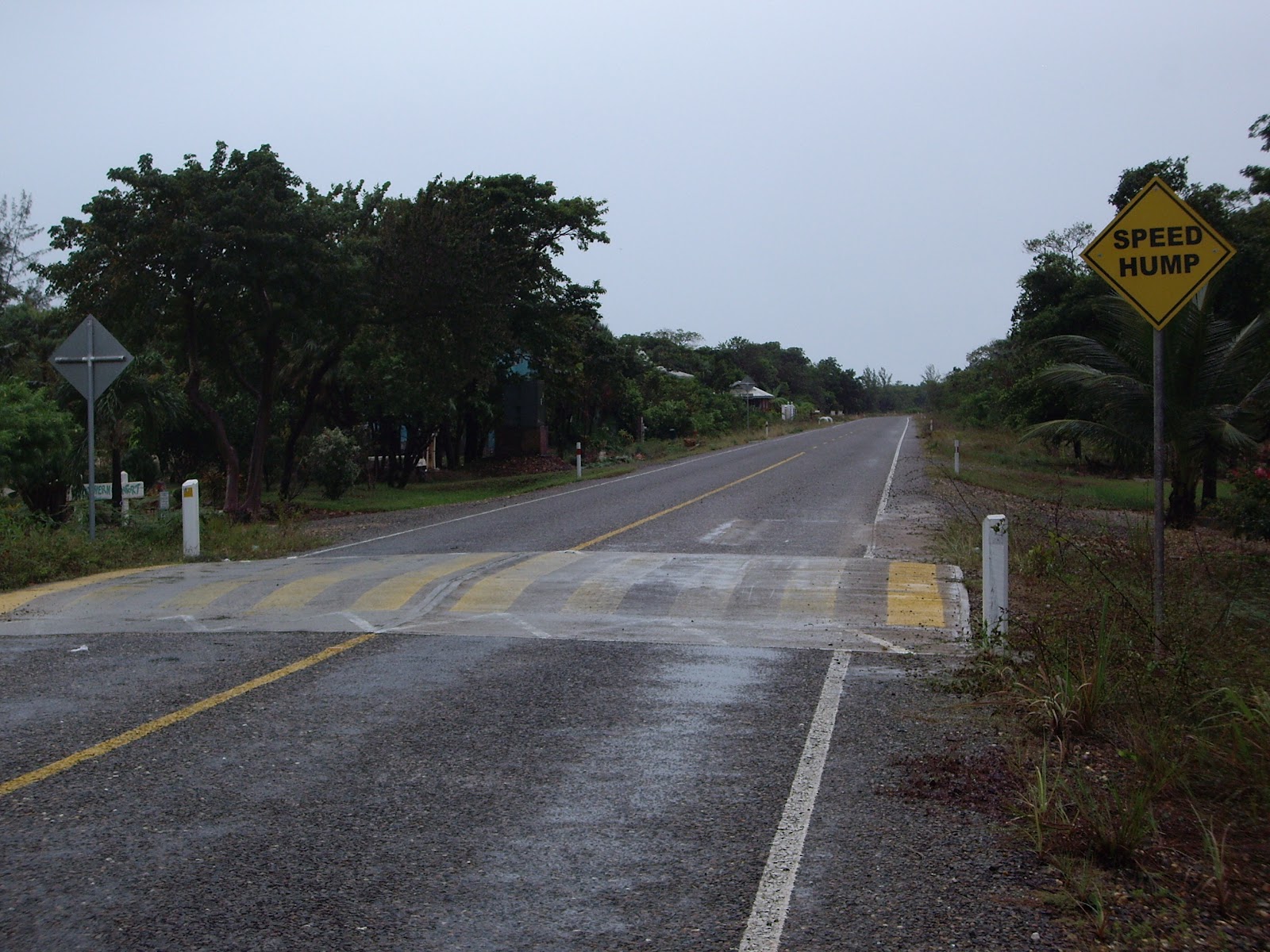
Driving in Belize was pretty trouble free.  Not to many signs telling you where to turn or the name or number of a highway, but there aren't very many highways to choose from.  Most roads are well maintained with pot holes only evident on the Hummingbird Highway.  As I mentioned before, making a left turn is different.  Pull to the right and wait for the traffic in both directions to pass before turning.  There are some place where there are left turn lanes.  They just happen to be on the right side of the road.  At every town, village and small settlement there are some very large speed humps.  They don't look like much from a distance, but their about a foot high and if you hit one at high speed, they will cause severe damage to your car not to mention causing it to go airborne, so lookout!


GETTING READY FOR THE FLIGHT HOME.

The Philip Goldson International Airport near Belize City is the country's main airport.  Small by most standards, it handles mostly small commuter planes and about 8 large jet flights a day.  So when we taxied out for take off, I wondered what was up when we stopped short of the runway for about 5 minutes.  As I was looking out the window I saw and airport employee with a large sack chasing a very large Igauna.  Wouldn't want one sucked in the engine.


JUNGLE FLOWER

We had a great time in Belize.  It was very relaxing and stress free.  Both Cathie and I agree that at some point we will be returning.  We couldn't have asked for more with our rental and the staff at Maine Stay.  With the best snorkeling ever and the unmatched experience of floating down a river inside a dark cave, this trip was one of the highlights of Gassaway's Adventures.

You can also see some more photos at Gary and Diane's blog.


Monday, March 12, 2012

BELIZE PART 4 - RAIN IN THE RAIN FOREST


We had a couple of days of rain, so I figured it was a good time to visit the rain forest. My traveling companions decline the opportunity to get wet and elected to stay back and rest up for the next meal.  Cockscomb Basin Wildlife Sanctuary is a unique sanctuary in southern Belize. It covers an area of about 150 square miles of tropical forest, and is the world's only Jaguar Preserve. Declared a Forest Preserve in 1984 and finally a Jaguar Preserve in 1986, the park is the culmination of many years of work and perseverance by individuals and national and international organizations.

The park area is rich in beauty, wildlife and even Maya culture.  The Cockscomb Mountain Range towers over the basin to the north. The highest mountain in Belize, Victoria Peak at 3,675 feet presides over the range and offers in its largely unexplored reaches chances for unrivaled exploration and adventure.  Unfortunately Victoria Peak was not in plans for the day. The 17 mile climb to the summit is only for the extremely fit and determined and climbable only in the dry season, with a guide. Be warned, it takes 4 days, and has turned grown men into gibbering wrecks.  Some say that I'm a gibbering wreck most of the time so I didn't want to push my luck.

Rainfall averages anywhere from 100 to 180 inches a year and on the day of my visit it rained the entire time.  After paying my entrance fee of $5, it is about a 6 mile drive on a muddy but passable road to the park.

THE ROAD IN


DON'T TELL THE RENTAL COMPANY


The Jaguar is the third largest member of the cat family and endangered in most of its range. At Cockscomb, the Jaguar is doing quite well and is by no means the only beneficiary of the safety of the preserve.   A visit to the Jaguar Preserve may likely provide one with signs of recent Jaguar activity, but it is highly unlikely that an actual Jaguar sighting will occur. These rare animals are masters of stealth and their very existence is based on their seeing, but not being seen. Other cats such as the Puma, Ocelot, Jaguarundi and Margay, as well as Peccary, Paca, Brocket Deer, Tayra, Otter and Coatimundi, enjoy a population density difficult to achieve in most locations. Now I don't profess to know what all the above animals are but I was hoping to see some wild animal, but I never did. 

This is what happens if you park your car for too long in the jungle.

At the visitor center I was provided with a map of the different trails in the preserve.  Because of the pouring rain and lack of rain gear, I opted for a short on hour walk on one of the loop trails in the park.


This is a termite nest beside the trail.  They are plentiful and I even saw them around Placencia.  I also saw some pretty big ant hills and there very large inhabitants.


Walking of the trail is just not possible.  The foliage is just too thick.  A machete is required plus a lot of work.  While driving around Belize we often saw people walking beside the road and most of them carried a machete.


Just think about trapezing through the jungle grabbing on to tree trunks to keep you balance.  This particular tree is very common and has very fine needles all over the trunk.  That's not all, there are many poisonous plants.

Ah, sap! It’s all New England and maple sugar candy, right? Not quite. Here in Belize, some trees ooze chichem, an entirely different type of sap. If it hits your bare skin, it causes a third-degree burn & massive welts. It has a tendency to spread, because it’s a sticky oil, so you have to be careful.  How do you get hit by chichem? Basically by being inexperienced. When clearing brush say, the novice might be a bit wild when they swing their machetes, and hit nearby trees. (The Maya workers use much more short, controlled movements when using the machete). If you hit the trees, the chichem flies, and hits your bare skin. Ouch!

 JUST AN INTERESTING LEAF


HOT LIPS FLOWER

I saw this flower several times on my hike.  I stopped at the visitor center on the way out to ask what it was called.  They didn't know, so I found the name with Google.  Hot lips is the common name but is really called Psychotria poeppigiana. Say that three times fast.


A short distance of the park road is this 4-seater Cessna which crashed back in 1984 when Alan Rabinowitz chartered it to do a routine tracking of the signals on the collars of the jaguars (neither the pilot nor Alan were seriously injured in the crash). Alan had studied the jaguars, and had worked with the locals in finding them, placing monitoring devices, and tracking their movements. Airplanes were used to track the signals, and their movements were recorded and studied. The plane, which encountered problems on take-off, causing it to hit a tree and crash, is now overgrown with shrubs and vines.

By this time I was pretty wet, so I figured it was time to head back and rejoin the rest of the crew.  Upon my arrival I learned that everyone was well rested and ready for dinner.  We headed into Placencia and decided on Italian.  We had one of the best meals of our trip at La Dolce Vita, whose owner/chef immigrated from Italy 8 years ago after a visit to Belize.  He met his future wife and made the move opening a restaurant.  After being in business for 8 years, he said he's staying put.  With her dinner Cathie order a Lighthouse Beer,a product of Belize that she's grown fond of, but the waiter said they only carried premium beers.  Not wanting something different, Cathie declined the offer of something else.  The waiter later returned with her requested beer, having run across the street to the market to get a couple of bottles.  The charge?  The store price of $1.25.